In 2026, successful MFDs and IFAs rely on the best mutual fund software for IFA in India to gain complete visibility over brokerage and payouts. Advanced brokerage analytics dashboards replace manual reports, reduce errors, and help distributors scale their business with full control.
Every Mutual Fund Distributor starts with the same goal, to build trust, grow AUM, and earn stable brokerage. However, as business grows, complexity increases. Brokerage comes from multiple sources. Sub-brokers need payouts. Reports are scattered. Calculations take time.
This is where the top mutual fund software For IFA in India becomes less of a “tool” and more of a business foundation. Helping distributors move from reactive work to proactive planning.
Without proper systems, MFDs often spend more time calculating brokerage than actually growing their business.
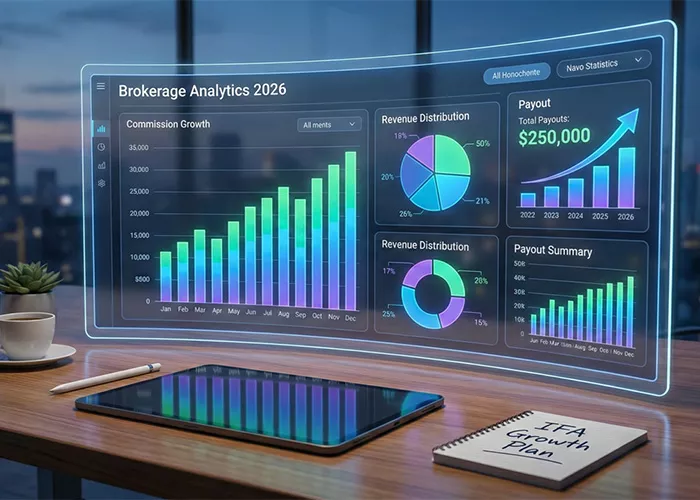
A brokerage analytics dashboard gives MFDs a complete view of their brokerage business on a single, easy-to-read screen. Instead of managing multiple Excel files and manual calculations, distributors can instantly understand how their business is performing.
With one dashboard, MFDs can clearly see:
Earlier, tracking brokerage meant opening several reports, matching figures, and double-checking numbers, often leading to errors and delays.
Key benefits of a single brokerage dashboard:
When brokerage data is presented clearly and visually, MFDs can make quicker, more confident decisions - focusing on growth rather than calculations.
Modern software allows MFDs to analyse brokerage for:
This flexibility helps distributors compare performance across time periods and identify growth patterns without doing extra work.
At the top of a brokerage dashboard, MFDs see three key figures:
These three numbers give instant clarity on profitability, helping MFDs plan expenses, expansion, and future hiring.
Many MFDs track AUM but ignore brokerage efficiency.
AUM vs brokerage comparison helps you understand:
This insight is critical for long-term business sustainability.
Not all clients contribute equally to brokerage.
With proper analytics, MFDs can clearly see:
This allows smarter time allocation and better service planning.
Earlier, payouts were calculated manually and shared individually.
Now, MFDs can:
Sub-brokers can view payout reports filtered by:
This reduces follow-up calls and builds trust within the distribution network.
Different sub-brokers often have different payout structures.
Modern systems allow MFDs to:
Accurate accounting is critical for compliance and clarity.
Updated brokerage reports now show:
This reduces accounting errors and improves financial discipline.
Manual brokerage file uploads are time-consuming.
Automation now allows:
This gives MFDs more time to focus on clients and growth.
In 2026, growth will belong to distributors who:
Those relying on manual processes will struggle to scale.
For MFDs and IFAs, brokerage is not just income, it is the pulse of the business.
When brokerage data is clear, visual, and automated, decisions are improved, growth becomes predictable and stress is reduced. The right mutual fund software transforms brokerage management from a headache into a strategic advantage.